Why Is My Coolant Disappearing?
You fill the coolant reservoir, drive normally for a few days or weeks, and then check it again—the coolant level is low.
There may not even be a puddle underneath the vehicle.
So, why is my coolant disappearing?
Coolant doesn't normally disappear without a reason. If your vehicle repeatedly needs coolant, the cooling system may have an external leak, internal engine leak, radiator problem, failing water pump, damaged hose, leaking reservoir or cap, heater-core leak, or another cooling-system issue.
Some coolant leaks are easy to see. Others only occur when the engine is hot and the cooling system is pressurized. Internal leaks may not leave any coolant underneath the vehicle at all.
Ignoring coolant loss can eventually cause the engine to overheat, potentially turning a cooling-system repair into a much more serious engine problem.
At Apex Automotive Care, we diagnose coolant loss and overheating problems for drivers throughout Houston, Southwest Houston, Westchase, Bellaire, Meyerland, Stafford, Sugar Land, and Missouri City.
Is It Normal for Coolant to Disappear?
Your cooling system is designed to contain and circulate coolant rather than continuously consume it.
A very small change in the reservoir level can occur as coolant expands and contracts with temperature, which is why coolant should be checked according to the manufacturer's instructions and compared under similar conditions.
But if you repeatedly need to add coolant, that's different.
Coolant that consistently drops below the proper level deserves investigation.
The coolant is likely:
- Leaking externally
- Escaping when the system is hot
- Entering another part of the vehicle
- Being lost internally through the engine
- Escaping through a cooling-system component
Simply adding coolant every time the level drops doesn't identify or repair the underlying problem.
Why Does My Coolant Keep Disappearing?
There are several possible causes, ranging from relatively straightforward external leaks to more serious internal engine problems.
1. Radiator Leak
The radiator is one of the major components responsible for controlling engine temperature.
Coolant circulates through the radiator, where heat is transferred away from the fluid before it returns to the engine.
A radiator can develop leaks from:
- Cracks
- Corrosion
- Damaged seams
- Connection points
- Physical damage
- Age-related deterioration
Small radiator leaks aren't always obvious.
Coolant may only escape when the cooling system becomes hot and pressurized. It may then evaporate from a hot surface before enough liquid reaches the ground to create a noticeable puddle.
If your coolant level keeps dropping, the radiator should be included in the inspection.
2. Leaking Radiator or Coolant Hose
Your vehicle uses hoses to carry coolant between the engine, radiator, heater core, and other cooling-system components.
Over time, hoses can deteriorate.
Possible problems include:
- Cracks
- Small pinhole leaks
- Loose connections
- Damaged clamps
- Swelling
- Soft spots
- Heat-related deterioration
A hose can sometimes leak only when the cooling system is under pressure.
That means you may park overnight and see absolutely nothing underneath the vehicle even though coolant is escaping while you're driving.
3. Water Pump Leak
The water pump circulates coolant throughout the engine and cooling system.
Depending on its design, a failing water pump can develop an external coolant leak.
Possible symptoms may include:
- Gradually disappearing coolant
- Coolant residue near the engine
- Overheating
- Unusual noises
- Coolant smell
- Temperature fluctuations
A water-pump problem can become particularly serious if coolant circulation is affected.
Without proper circulation, the engine may overheat even if some coolant remains in the system.
4. Coolant Reservoir Leak
The coolant expansion or overflow reservoir itself can crack or develop leaks.
Small cracks can be difficult to see.
The reservoir may appear normal when the engine is cold but leak once coolant expands and system temperatures increase.
Possible clues include:
- Dried coolant residue around the reservoir
- Wetness underneath the tank
- Coolant smell
- Level repeatedly dropping
- Cracks around hose connections
The reservoir and its connections should be inspected if coolant seems to disappear without an obvious radiator leak.
5. Bad Radiator Cap or Coolant Reservoir Cap
A small cap can create a surprisingly significant problem.
Depending on the vehicle's cooling-system design, the radiator or coolant reservoir cap helps maintain the correct pressure.
If the cap can't seal or regulate pressure correctly, coolant may escape.
Possible signs can include:
- Coolant around the cap
- Dried coolant residue
- Coolant smell after driving
- Coolant loss
- Overheating
- Overflow from the reservoir
The cap is only one possible cause, so it shouldn't automatically be replaced without inspecting the rest of the cooling system.
Why Is My Coolant Disappearing but There Is No Leak?
This is one of the most confusing situations for vehicle owners.
You check the coolant and notice it's low, but there's no puddle underneath the car.
That doesn't necessarily mean the cooling system isn't leaking.
There are several ways coolant can disappear without leaving an obvious puddle.
A Leak Only Happens When the Engine Is Hot
The cooling system operates under pressure.
A small leak may only open when:
- The engine reaches operating temperature
- Cooling-system pressure increases
- A hose expands
- A connection becomes hot
- The vehicle is being driven
The leaking coolant may land on hot engine components and evaporate.
By the time you park and look underneath the vehicle, there may be no obvious evidence.
Coolant Is Leaking Internally
An internal leak can allow coolant to enter areas where you won't see it dripping onto the ground.
Possible internal engine problems include a damaged head gasket or another sealing issue.
The Heater Core Is Leaking
Coolant can also leak inside the passenger compartment through the heater core.
In that situation, the coolant isn't necessarily going onto the ground underneath the engine.
That's why “I don't see a leak” doesn't mean coolant loss should be ignored.
6. Heater Core Leak
The heater core is a small heat exchanger that uses hot engine coolant to provide cabin heat.
If it develops a leak, coolant can enter the HVAC housing or passenger compartment.
Possible signs include:
- Sweet coolant smell inside the vehicle
- Windows fogging unusually
- Damp carpeting
- Coolant loss
- Poor heater performance
- Film developing on the inside of the windshield
A heater-core leak may not create the type of puddle you'd expect from an engine-bay coolant leak.
7. Head Gasket Problem
A head-gasket problem is one of the more serious possible causes of unexplained coolant loss.
The head gasket helps seal the cylinder head to the engine block while keeping combustion pressure, coolant, and engine oil in their proper passages.
If the gasket fails in certain ways, coolant can enter the combustion chamber or another part of the engine.
Possible symptoms can include:
- Coolant disappearing without an obvious external leak
- Repeated overheating
- White exhaust smoke or vapor
- Engine misfires
- Rough running
- Bubbles in the cooling system
- Cooling-system pressure problems
- Oil and coolant contamination in some cases
However, coolant loss alone does not prove that your vehicle has a blown head gasket.
External leaks and other cooling-system problems should also be considered and tested.
8. Internal Engine Coolant Leak
The head gasket isn't the only possible source of internal coolant loss.
Depending on engine design, coolant may potentially escape through other gaskets, seals, housings, or damaged engine components.
Because internal leaks may leave no visible puddle, diagnosis can require additional testing.
Don't assume the worst based solely on a dropping coolant level.
Have the cooling system properly evaluated.
Why Does My Coolant Disappear Only When I Drive?
If coolant drops primarily after driving, the leak may depend on temperature and pressure.
When the engine warms up:
- Coolant temperature increases.
- The coolant expands.
- Cooling-system pressure rises.
- A weak hose, seal, radiator, reservoir, or connection may begin leaking.
- Coolant may land on hot surfaces and evaporate.
After the vehicle cools down, the leak may slow considerably or stop.
This can make temperature-dependent coolant leaks difficult to spot during a simple visual inspection.
Why Does My Coolant Reservoir Keep Going Empty?
If the reservoir repeatedly goes from the correct level to nearly empty, don't simply refill it indefinitely.
Possible causes include:
- External coolant leak
- Radiator leak
- Hose leak
- Water-pump leak
- Reservoir leak
- Pressure-cap problem
- Heater-core leak
- Internal engine leak
- Cooling-system pressure problem
The reservoir itself may not be the failed component.
It's simply where you're noticing the missing coolant.
Why Is My Coolant Disappearing With No Overheating?
A coolant leak doesn't always cause immediate overheating.
If the leak is small, enough coolant may remain in the system to control engine temperature—for now.
But if coolant continues escaping, the level can eventually become low enough that the cooling system can no longer manage engine heat effectively.
That's why coolant loss should be diagnosed before the temperature gauge reaches the red.
Waiting for overheating means waiting until the problem becomes more serious.
Why Is My Coolant Disappearing but My Car Runs Fine?
A vehicle can appear to run perfectly normally during the early stages of coolant loss.
You may have:
- No warning lights
- No overheating
- No rough running
- No visible leak
- Normal acceleration
and still have a cooling-system leak.
A small leak can develop gradually.
The fact that the vehicle currently runs well doesn't explain where the coolant is going.
If the level continues dropping, investigate the cause.
Why Do I Have to Keep Adding Coolant?
Repeatedly adding coolant means the system deserves attention.
Coolant isn't comparable to gasoline, which is intentionally consumed during normal vehicle operation.
The cooling system is designed to continuously circulate coolant.
If you're regularly topping it off, determine why the level keeps dropping.
Adding coolant can temporarily restore the proper level, but it doesn't repair:
- A leaking radiator
- Damaged hose
- Failed water pump
- Cracked reservoir
- Heater-core leak
- Pressure problem
- Internal engine leak
Can Coolant Evaporate?
Coolant inside a properly functioning sealed cooling system shouldn't simply disappear in significant quantities through normal evaporation.
However, coolant escaping from a small leak can contact hot engine components and evaporate before reaching the ground.
That can make it appear as though the coolant itself simply vanished.
You may notice a sweet smell or dried residue instead of a puddle.
What Does a Coolant Leak Smell Like?
Automotive coolant often has a distinctive sweet smell.
If you notice a sweet or unusual chemical odor:
- Under the hood
- After parking
- Near the front of the vehicle
- Through the air vents
- Inside the passenger compartment
a cooling-system leak may be present.
The location of the odor can sometimes help narrow down where the coolant is escaping, although proper inspection is still necessary.
What Color Is Leaking Coolant?
Coolant isn't always green.
Depending on the manufacturer and coolant specification, it may appear:
- Green
- Orange
- Yellow
- Pink
- Red
- Blue
- Purple
- Another color
Color alone shouldn't be used to determine which coolant belongs in your vehicle.
Always use the coolant specification recommended for your specific vehicle.
Mixing incompatible coolant types can potentially create additional cooling-system problems.
Can a Coolant Leak Cause My Car to Overheat?
Yes.
Coolant absorbs engine heat and transports it through the cooling system.
As coolant disappears, the system may eventually become unable to control engine temperature.
You may notice:
- Temperature gauge climbing
- Temperature warning light
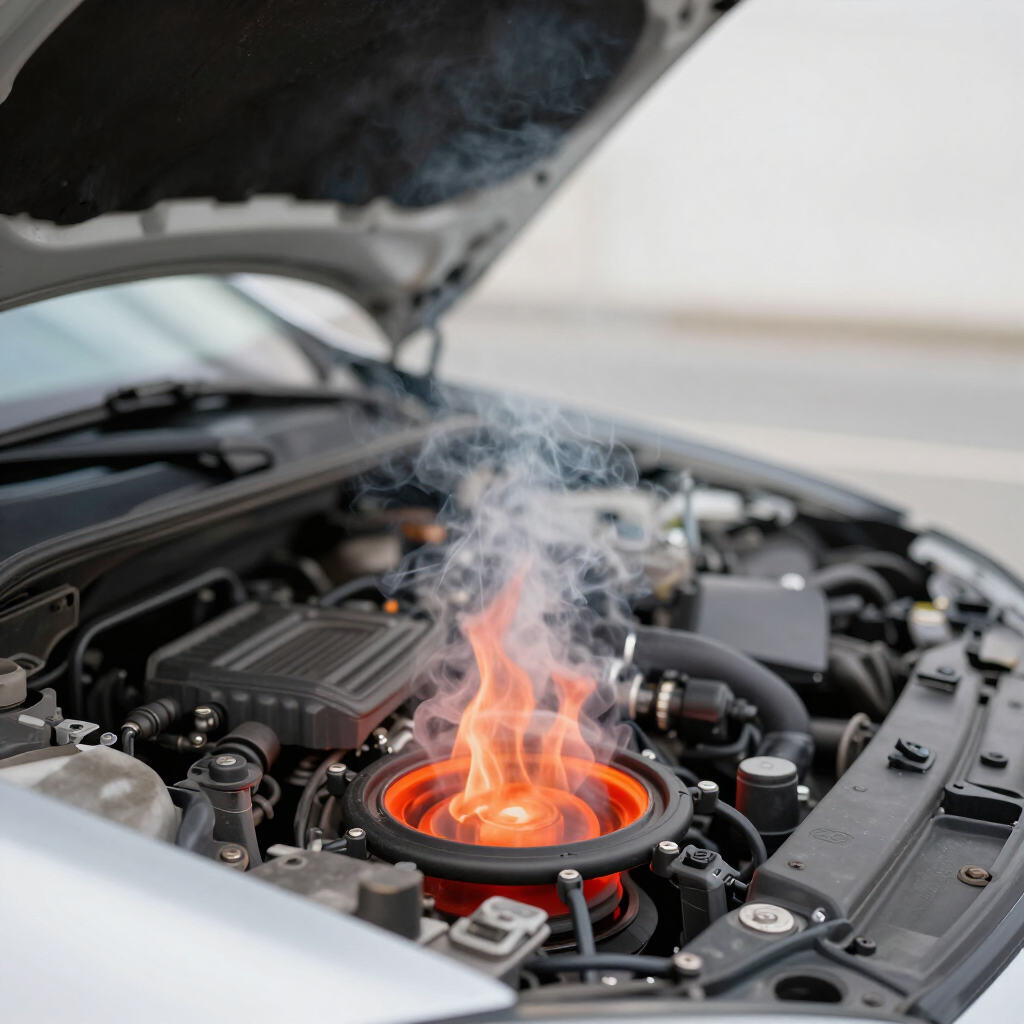
- Steam
- Poor heater operation
- Coolant smell
- Engine performance changes
- Overheating in traffic
If your vehicle is already overheating, continuing to drive can increase the risk of serious engine damage.
Read our related guide:
Can I Drive My Car If It's Overheating? | Houston Auto Repair
Can I Keep Driving If My Coolant Is Disappearing?
It depends on the severity of the coolant loss, but repeated coolant loss shouldn't be ignored.
A small leak can become larger.
If the coolant level becomes too low, the engine may overheat.
Stop driving and have the vehicle evaluated if you notice:
- Engine overheating
- Temperature warning light
- Steam
- Rapid coolant loss
- Large coolant leak
- Severe engine performance problems
- Coolant mixed with engine oil
- Significant white exhaust smoke
If the engine is hot, never remove the radiator cap.
Hot pressurized coolant can cause severe burns.
Can I Just Add More Coolant?
Adding the correct coolant can restore the level, but it doesn't solve the reason the coolant disappeared.
Think of topping off coolant as addressing the symptom, not necessarily the cause.
If you add coolant once because the level is slightly low and it remains stable afterward, continue monitoring it.
If you repeatedly have to add coolant, schedule an inspection.
How Do Mechanics Find a Coolant Leak?
Finding disappearing coolant may require more than looking underneath the vehicle.
Visual Inspection
A technician can inspect:
- Radiator
- Hoses
- Reservoir
- Water pump area
- Connections
- Clamps
- Engine components
- Cooling-system fittings
Dried coolant residue can sometimes reveal a leak even when the component isn't actively dripping.
Cooling-System Pressure Test
A pressure test can help expose leaks that aren't easily visible under normal conditions.
By pressurizing the cooling system appropriately, technicians may be able to identify where coolant is escaping.
Radiator and Reservoir Inspection
Cracks, damaged connections, corrosion, and pressure-related leaks may be inspected.
Water Pump Inspection
The water pump can be checked for leakage, abnormal operation, noise, or other signs of failure.
Heater-Core Inspection
If coolant appears to be entering the passenger compartment, the heater core and HVAC system may need further inspection.
Internal Leak Testing
If no external leak can be found, additional tests may be needed to determine whether coolant is entering the engine internally.
The correct diagnostic process depends on the vehicle's symptoms.
Why Proper Coolant-Leak Diagnosis Matters
If your coolant keeps disappearing, guessing can become expensive.
Replacing the radiator won't fix a leaking water pump.
Replacing a water pump won't fix a damaged hose.
And repeatedly adding coolant won't repair an internal leak.
The goal should be to locate the source of the coolant loss before deciding what needs replacement.
Apex Automotive Care's cooling-system service covers components including the radiator, hoses, thermostat, water pump, coolant condition, leaks, and cooling-system maintenance.
Cooling System Repair in Houston, TX
How Can I Help Prevent Cooling-System Problems?
Not every leak can be prevented, but routine inspections can help identify developing problems before they lead to overheating.
Pay attention to:
- Coolant level
- Fluid leaks
- Coolant smells
- Temperature-gauge behavior
- Warning lights
- Hose condition
- Manufacturer-recommended maintenance
If you notice the coolant level beginning to change, don't wait until the reservoir becomes completely empty.
Apex Automotive Care provides routine maintenance and vehicle inspections for Houston drivers.
General Vehicle Maintenance in Houston, TX
You can also follow the maintenance intervals recommended for your vehicle:
Factory Scheduled Maintenance in Houston, TX
Why Coolant Loss Matters for Houston Drivers
Houston's climate can put substantial demands on a vehicle's cooling system.
During hot weather, your cooling system must manage engine heat while you may also be dealing with:
- Stop-and-go traffic
- Long commutes
- Extended idling
- High outside temperatures
- Heavy air-conditioning use
Hot weather doesn't cause coolant to mysteriously disappear from a properly functioning sealed system.
If your coolant level repeatedly drops, there is likely a reason that should be investigated.
Coolant Leak Repair in Westchase
If you live or work in Westchase and repeatedly need to add coolant, have the cooling system checked before the vehicle begins overheating.
A small leak can potentially become a much larger problem.
Coolant Leak Repair in Bellaire
Drivers in Bellaire who notice disappearing coolant shouldn't rely only on whether there is a puddle underneath the car.
Some coolant leaks occur only when the vehicle is hot, while others can be internal.
Coolant Leak Repair in Meyerland
If your coolant reservoir keeps going empty in Meyerland, Apex Automotive Care can inspect the cooling system for leaks and other problems.
Finding the source early may help prevent an overheating breakdown.
Coolant Leak Repair in Stafford
Drivers commuting from Stafford should pay attention to repeated coolant loss, particularly before longer trips into Houston.
If you're continually topping off the reservoir, the cooling system should be inspected.
Coolant Leak Repair in Sugar Land
If you're in Sugar Land and your coolant keeps disappearing without an obvious leak, the system may need pressure testing and further diagnosis.
The absence of a puddle doesn't rule out coolant loss.
Coolant Leak Repair in Missouri City
Drivers in Missouri City experiencing unexplained coolant loss can have the radiator, hoses, reservoir, water pump, and other cooling-system components inspected.
Internal leak testing may also be appropriate if no external leak can be found.
Coolant Leak Repair in Southwest Houston
Apex Automotive Care provides cooling-system diagnosis and repair for drivers throughout Southwest Houston.
Our shop is located at:
Apex Automotive Care
7050 Southwest Freeway
Houston, TX 77074
We serve drivers throughout Southwest Houston, Westchase, Bellaire, Meyerland, Stafford, Sugar Land, Missouri City, and surrounding Houston communities.
Frequently Asked Questions About Disappearing Coolant
Why is my coolant disappearing?
Coolant may disappear because of a radiator leak, hose leak, water-pump problem, leaking reservoir, faulty pressure cap, heater-core leak, or an internal engine leak.
Why is my coolant disappearing but there is no leak?
Some leaks only occur when the cooling system is hot and pressurized. Coolant can also evaporate from hot engine surfaces or leak internally, meaning you may never see a puddle.
Is it normal to lose coolant over time?
A significant or recurring drop in coolant isn't something to treat as normal. If you're repeatedly adding coolant, have the cooling system inspected.
Why does my coolant reservoir keep going empty?
Possible causes include external leaks, radiator problems, damaged hoses, a leaking water pump, reservoir problems, heater-core leaks, pressure problems, or internal engine leaks.
Can coolant disappear without overheating?
Yes. A small coolant leak may exist before enough coolant has been lost to cause overheating. That makes early diagnosis important.
Why is my coolant disappearing but my car runs fine?
Small leaks can develop without immediately affecting engine performance. The vehicle may run normally until enough coolant is lost to create a temperature problem.
Can coolant evaporate without a leak?
Significant recurring coolant loss shouldn't normally occur in a properly functioning sealed system. However, coolant leaking onto hot engine components may evaporate before forming a visible puddle.
Does disappearing coolant mean I have a blown head gasket?
Not necessarily. A head-gasket problem is one possible cause, but external leaks from the radiator, hoses, water pump, reservoir, and other components can also cause coolant loss.
How do I know if coolant is leaking internally?
Possible clues can include unexplained coolant loss, repeated overheating, white exhaust smoke or vapor, engine misfires, cooling-system pressure abnormalities, or fluid contamination. Proper testing is needed to confirm an internal leak.
Can a bad water pump cause coolant to disappear?
Yes. Depending on the type of failure, a water pump can leak coolant and may also affect coolant circulation.
Why does my coolant disappear only after driving?
Some leaks occur primarily when the engine is hot and the cooling system is under pressure. The coolant may escape while driving and evaporate before you park.
Can I keep adding coolant instead of fixing the leak?
Adding coolant can temporarily restore the level, but it doesn't repair the underlying cause. Repeated coolant loss should be diagnosed.
Can disappearing coolant damage my engine?
Yes. If coolant loss eventually causes the engine to overheat, continued driving can potentially lead to serious engine damage.
Where can I get a coolant leak checked in Houston?
Apex Automotive Care provides cooling-system diagnosis and repair at 7050 Southwest Freeway, Houston, TX 77074, serving Southwest Houston, Westchase, Bellaire, Meyerland, Stafford, Sugar Land, Missouri City, and surrounding Houston communities.
Don't Ignore Disappearing Coolant
If you're asking “Why is my coolant disappearing?”, something is likely causing coolant to leave the cooling system.
The problem could be an obvious external leak—or something much harder to see.
Possible causes include:
- Radiator leak
- Damaged hose
- Water-pump leak
- Coolant reservoir problem
- Pressure-cap problem
- Heater-core leak
- Internal engine leak
- Head-gasket problem
The important thing is to identify the cause before coolant loss turns into engine overheating.
At Apex Automotive Care, we can inspect your vehicle's cooling system, locate the source of coolant loss, and explain what repairs your vehicle actually needs.
Apex Automotive Care
📍
7050 Southwest Freeway, Houston, TX 77074